# Command Infrastructure
This document describes the generic command infrastructure that lives in the `network/` layer.
It covers the parsing pipeline, the routing pipeline, and the base types that every command builds on.
The infrastructure is intentionally project-agnostic: It has no knowledge of specific commands and is never modified when a new command is added.
## Overview
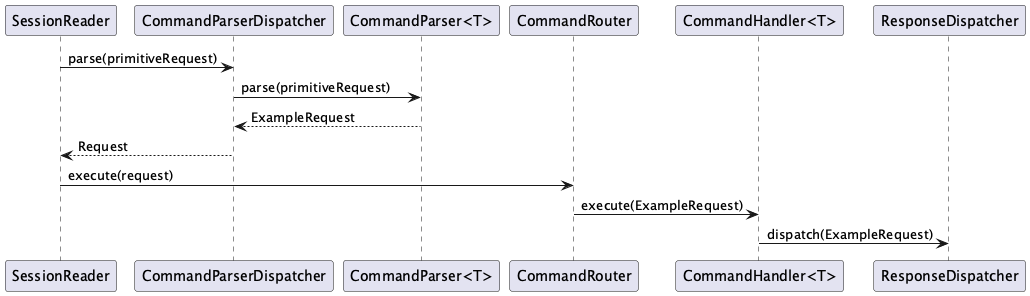
An incoming request travels through two sequential pipelines: **parsing** and **execution**.
The parsing pipeline converts a stringly-typed `PrimitiveRequest` into a strongly-typed `Request` subclass.
The execution pipeline routes that typed request to the correct handler, which produces a `Response`.
 ## Parsing Pipeline
### `CommandParser`
## Parsing Pipeline
### `CommandParser`
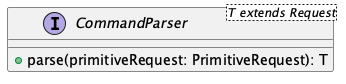 The `CommandParser` is a single-method interface responsible for converting a `PrimitiveRequest` into a concrete, typed `Request` subclass.
Implementations live in `app/commands//` and are registered by name in `CommandParserDispatcher`.
The parser is the correct place to validate and extract parameters.
If a required parameter is absent, `RequestParameterAccessor.require(...)` throws an `MissingParameterException`, which the `SessionReader` catches and converts into a `MISSING_PARAMETER` error response for the client.
Parsers **do not** perform any domain logic. Their only job is extraction and type conversion.
### `CommandParserDispatcher`
The `CommandParser` is a single-method interface responsible for converting a `PrimitiveRequest` into a concrete, typed `Request` subclass.
Implementations live in `app/commands//` and are registered by name in `CommandParserDispatcher`.
The parser is the correct place to validate and extract parameters.
If a required parameter is absent, `RequestParameterAccessor.require(...)` throws an `MissingParameterException`, which the `SessionReader` catches and converts into a `MISSING_PARAMETER` error response for the client.
Parsers **do not** perform any domain logic. Their only job is extraction and type conversion.
### `CommandParserDispatcher`
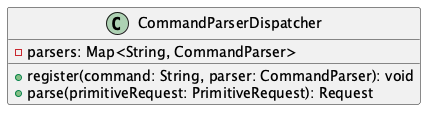 The `CommandParserDispatcher` holds a map from command name strings (e.g. `"PING"`) to their corresponding `CommandParser`.
When the `SessionReader` receives a `PrimitiveRequest`, it calls `dispatcher.parse(...)`, which looks up the parser by the request's command string and delegates parsing.
If no parser is registered for the command name, `parse(...)` throws an `UnknownCommandException`, which `SessionReader` catches and converts into an `UNKNOWN_COMMAND` error response for the client.
### `RequestParameterAccessor`
The `CommandParserDispatcher` holds a map from command name strings (e.g. `"PING"`) to their corresponding `CommandParser`.
When the `SessionReader` receives a `PrimitiveRequest`, it calls `dispatcher.parse(...)`, which looks up the parser by the request's command string and delegates parsing.
If no parser is registered for the command name, `parse(...)` throws an `UnknownCommandException`, which `SessionReader` catches and converts into an `UNKNOWN_COMMAND` error response for the client.
### `RequestParameterAccessor`
 The `RequestParameterAccessor` is a helper provided to parsers for reading typed parameter values from a `PrimitiveRequest`.
It indexes the parameter list by key on construction for O(1) lookups.
```java
// Require a parameter — throws MissingParameterException if absent
String username = accessor.require("USERNAME");
// Require and parse — throws ParameterParseException if conversion fails
int count = accessor.require("COUNT", Integer::parseInt);
// Optional with a default
String mode = accessor.optional("MODE", "default");
```
The `ThrowingParser` functional interface accepted by the typed overloads allows any checked or unchecked exception to propagate from the conversion function.
The `RequestParameterAccessor` wraps it in a `ParameterParseException`.
## Execution Pipeline
### `Request`
The `RequestParameterAccessor` is a helper provided to parsers for reading typed parameter values from a `PrimitiveRequest`.
It indexes the parameter list by key on construction for O(1) lookups.
```java
// Require a parameter — throws MissingParameterException if absent
String username = accessor.require("USERNAME");
// Require and parse — throws ParameterParseException if conversion fails
int count = accessor.require("COUNT", Integer::parseInt);
// Optional with a default
String mode = accessor.optional("MODE", "default");
```
The `ThrowingParser` functional interface accepted by the typed overloads allows any checked or unchecked exception to propagate from the conversion function.
The `RequestParameterAccessor` wraps it in a `ParameterParseException`.
## Execution Pipeline
### `Request`
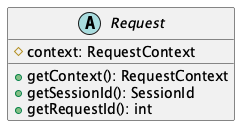 The `Request` is the abstract base class for all typed command requests. It carries a `RequestContext`, an immutable record containing the originating `SessionId` and the numeric `requestId`.
Both of which are later used by the handler to direct the response to the correct session.
Concrete subclasses add command-specific fields, all set via constructor. Requests are immutable value objects. They carry data, not behaviour.
### `CommandHandler`
The `Request` is the abstract base class for all typed command requests. It carries a `RequestContext`, an immutable record containing the originating `SessionId` and the numeric `requestId`.
Both of which are later used by the handler to direct the response to the correct session.
Concrete subclasses add command-specific fields, all set via constructor. Requests are immutable value objects. They carry data, not behaviour.
### `CommandHandler`
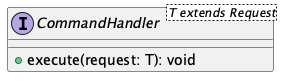 The `CommandHandler` is an abstract base class responsible for executing a typed request.
The handler contains the domain logic: reading from registries and managers, modifying state, and dispatching a response via the `ResponseDispatcher`.
Handlers receive their dependencies (the `ResponseDispatcher`, registries and managers etc.) through constructor injection.
They can also register reusable pre-execution checks via `addCheck(...)`. These checks are stored on the handler and are evaluated before `execute(...)` runs.
When a piece of trivial validation is shared by multiple handlers, it should be extracted into a dedicated `HandlerCheck` instead of being duplicated in each handler.
### `HandlerCheck`
The `CommandHandler` is an abstract base class responsible for executing a typed request.
The handler contains the domain logic: reading from registries and managers, modifying state, and dispatching a response via the `ResponseDispatcher`.
Handlers receive their dependencies (the `ResponseDispatcher`, registries and managers etc.) through constructor injection.
They can also register reusable pre-execution checks via `addCheck(...)`. These checks are stored on the handler and are evaluated before `execute(...)` runs.
When a piece of trivial validation is shared by multiple handlers, it should be extracted into a dedicated `HandlerCheck` instead of being duplicated in each handler.
### `HandlerCheck`
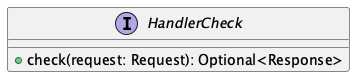 The `HandlerCheck` is a functional interface for reusable pre-execution validation.
Its `check(...)` method receives the incoming `Request` and returns an empty `Optional` if the request may continue.
If the check fails, it returns an `ErrorResponse` wrapped in the `Optional`, which will be dispatched to the client instead of calling the handler.
This is the right place for small shared checks such as "is the user logged in?" or other simple preconditions that multiple handlers need.
### `CommandHandlerExecutor`
The `HandlerCheck` is a functional interface for reusable pre-execution validation.
Its `check(...)` method receives the incoming `Request` and returns an empty `Optional` if the request may continue.
If the check fails, it returns an `ErrorResponse` wrapped in the `Optional`, which will be dispatched to the client instead of calling the handler.
This is the right place for small shared checks such as "is the user logged in?" or other simple preconditions that multiple handlers need.
### `CommandHandlerExecutor`
 The `CommandHandlerExecutor` runs all checks registered on a handler before invoking `execute(...)`.
If any `HandlerCheck` returns a response, the executor dispatches it immediately and aborts execution.
Otherwise, the handler is executed normally.
This keeps precondition handling separate from the actual domain logic inside the handler.
### `CommandRouter`
The `CommandHandlerExecutor` runs all checks registered on a handler before invoking `execute(...)`.
If any `HandlerCheck` returns a response, the executor dispatches it immediately and aborts execution.
Otherwise, the handler is executed normally.
This keeps precondition handling separate from the actual domain logic inside the handler.
### `CommandRouter`
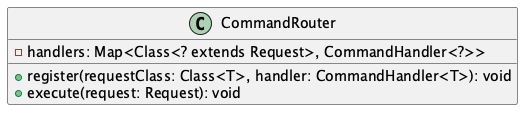 The `CommandRouter` maps `Request` subclasses to their handlers using the request's runtime class as the key.
The type safety of `register(...)` ensures that a handler can only be registered for the exact type it is parameterised on.
The unchecked cast in `execute(...)` is therefore safe by construction and is documented with a `@SuppressWarnings` comment in the source.
If no handler is registered for the given request type, `execute(...)` throws `UnknownRequestException`.
Unlike `UnknownCommandException` (which covers unknown command strings), this exception indicates a programming error i.e. a parser was registered without a corresponding handler.
## Response Types
The `CommandRouter` maps `Request` subclasses to their handlers using the request's runtime class as the key.
The type safety of `register(...)` ensures that a handler can only be registered for the exact type it is parameterised on.
The unchecked cast in `execute(...)` is therefore safe by construction and is documented with a `@SuppressWarnings` comment in the source.
If no handler is registered for the given request type, `execute(...)` throws `UnknownRequestException`.
Unlike `UnknownCommandException` (which covers unknown command strings), this exception indicates a programming error i.e. a parser was registered without a corresponding handler.
## Response Types
 The `Response` is the abstract base for all server responses. Its two concrete branches are `SuccessResponse` (prefix `+OK`) and `ErrorResponse` (prefix `-ERR`).
Command-specific responses extend `SuccessResponse` and populate the body using the `ResponseBodyBuilder`.
`OkResponse` is a pre-built convenience subclass of `SuccessResponse` with an empty body, used for commands that need only acknowledge success without returning data (e.g. `PING`).
The body is built with a fluent `ResponseBodyBuilder`:
```java
// Simple key/value parameters
new ResponseBodyBuilder()
.param("STATUS", UsernameAvailability.FREE)
.build();
// Nested block
new ResponseBodyBuilder()
.block("USER", b -> b
.param("ID", user.getId().value())
.param("NAME", user.getName()))
.build();
```
`ResponseEncoder` serialises the body into the wire format (tab-indented, `END`-terminated blocks) and wraps it in a `PrimitiveResponse`.
`ResponseDispatcher` then enqueues this into the target session's bounded response queue.
The `Response` is the abstract base for all server responses. Its two concrete branches are `SuccessResponse` (prefix `+OK`) and `ErrorResponse` (prefix `-ERR`).
Command-specific responses extend `SuccessResponse` and populate the body using the `ResponseBodyBuilder`.
`OkResponse` is a pre-built convenience subclass of `SuccessResponse` with an empty body, used for commands that need only acknowledge success without returning data (e.g. `PING`).
The body is built with a fluent `ResponseBodyBuilder`:
```java
// Simple key/value parameters
new ResponseBodyBuilder()
.param("STATUS", UsernameAvailability.FREE)
.build();
// Nested block
new ResponseBodyBuilder()
.block("USER", b -> b
.param("ID", user.getId().value())
.param("NAME", user.getName()))
.build();
```
`ResponseEncoder` serialises the body into the wire format (tab-indented, `END`-terminated blocks) and wraps it in a `PrimitiveResponse`.
`ResponseDispatcher` then enqueues this into the target session's bounded response queue.